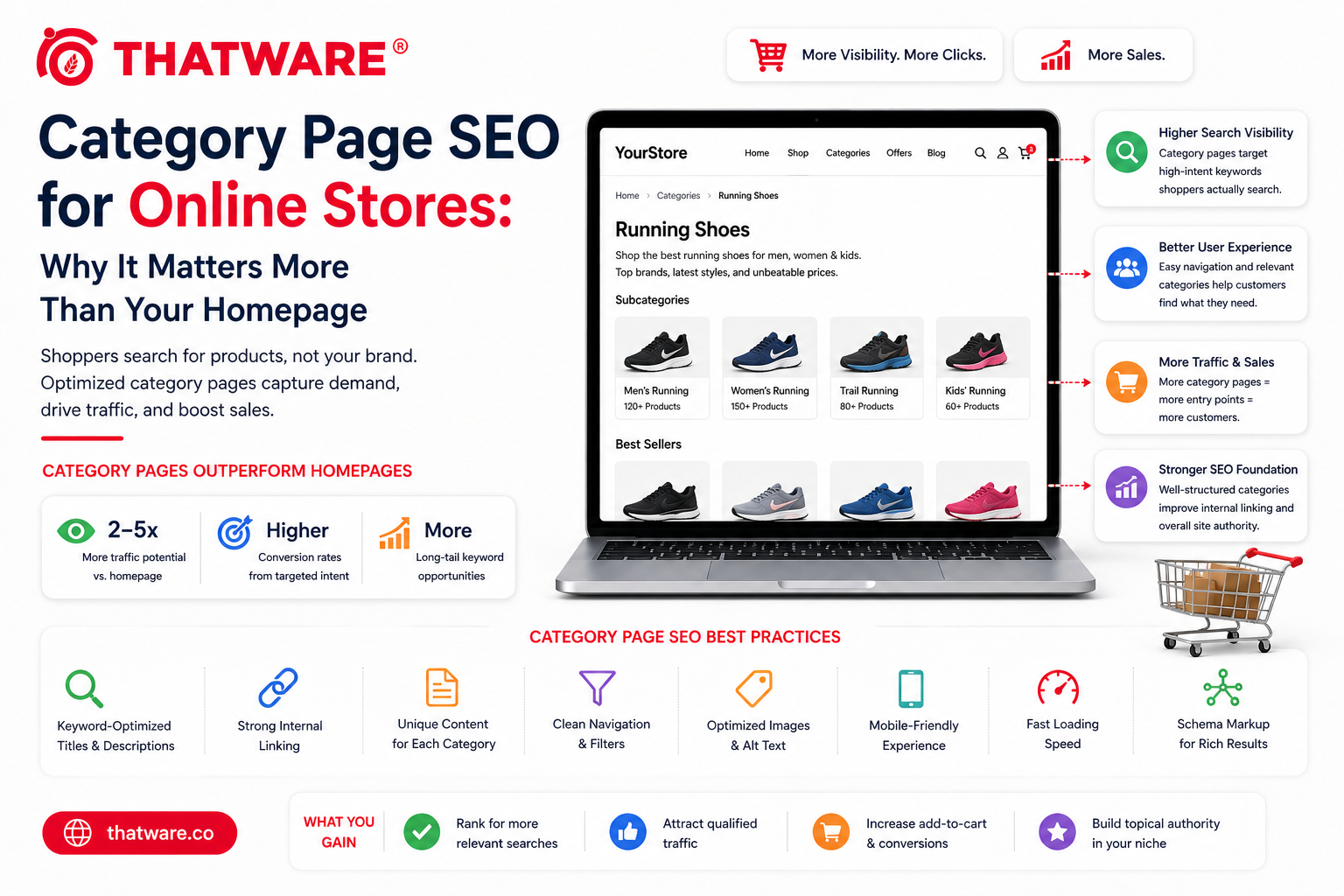
Here’s something that surprises a lot of e-commerce founders and marketing managers when they first really look at their search traffic data: the homepage is rarely where the organic search opportunity lives. The keywords your homepage ranks for tend to be branded — people searching for your company by name, who were going to find you anyway. The real commercial organic traffic — the people who didn’t know your brand existed but were searching for what you sell — that traffic arrives almost entirely through category pages and product pages.
And of the two, category pages are typically the higher-leverage opportunity. They target broader, higher-volume commercial intent queries. They serve as hubs of internal link authority that flow down to product pages. They’re the entry point for discovery-stage shoppers who are still figuring out what they want, not just comparing specific products. Getting category pages right has an outsized impact on overall e-commerce organic performance.
Most online stores haven’t got them right.
Related Style Intelligence
How Simple Electronics Projects Inspire a Lifelong Love for Science Convert Text to Video Easily With Automated ToolsThe Rise of AI-Driven Video Creation Understanding Temperature Sensors and Proximity Switch SensorsThe Structural Problems That Make Category Pages Fail
The most common category page SEO failure isn’t a lack of keywords — it’s a combination of structural and content problems that prevent the pages from signalling topical authority to search engines.
Thin or absent copy. The default configuration for most e-commerce platforms produces category pages that are almost entirely product grids. Some introductory text, perhaps a one-liner pulled from the category name, and then a page of product images and prices. This structure tells search engines very little about the topical relevance of the page beyond its URL structure and the product names on it. Pages with substantive, topically relevant copy consistently outrank those without it.
Faceted navigation creating duplicate content. When category pages generate filter-based URL variants — /women-shoes?color=black, /women-shoes?size=6, /women-shoes?brand=nike — the result can be hundreds or thousands of near-duplicate URLs that fragment link authority and create crawl budget waste. Managing this correctly — through canonical tags, noindex directives on filter combinations, or parameter handling configuration — is technically complex and chronically misimplemented.
Related Style Intelligence
Top 10 Questions Answered About Using AI to Automate Repetitive Tasks 20 Most Asked Questions About Skills Advancement in Mobile App DevelopmentPagination without proper management. Paginated category pages need careful handling to ensure that link authority consolidates appropriately on the primary page and that crawlers aren’t spending disproportionate budget on lower-priority pages.
Lack of internal link context. Category pages often receive links from navigation menus with generic anchor text and little else. Building a richer internal link context — editorial mentions in blog content, featured links from relevant informational pages, breadcrumb implementation that communicates hierarchy — strengthens the topical signals that support category page rankings.
The Content Problem: What Actually Works
Let me be direct about something that creates confusion in e-commerce content strategy: the content that helps category pages rank is not the same as the content that helps customers buy.
Shoppers using a category page want to see products. They want filtering functionality, high-quality images, price comparisons, and an efficient path to the products they’re considering. Long descriptive text at the top of the page that they have to scroll past to get to the products is friction, not value.
This creates a real tension with what SEO requires. Category pages without substantive text content are harder to rank, particularly in competitive categories where well-optimised competitors have invested in copy.
The solutions that work best in practice balance both needs:
Bottom-of-page editorial content. A 300–500 word section of genuinely useful, topically relevant copy at the bottom of the category page, below the product grid, satisfies the crawlers without creating friction for shoppers. This content should be substantive — covering what makes the category useful, what to consider when buying from it, relevant seasonal or contextual information — rather than keyword-stuffed filler.
Expandable/accordion copy at the top. A summary sentence or two with an expandable “read more” section allows interested users to access more information without forcing it on those who aren’t.
Rich meta content. Even if the on-page copy is minimal, well-crafted title tags, meta descriptions, and heading structure provide significant SEO value and don’t affect the shopping experience.
The online store seo content that performs best for category pages is the kind that a knowledgeable sales associate might offer — helpful, specific, relevant to the decision the buyer is making — not marketing copy, not keyword-dense padding.
Keyword Strategy for Category Pages
The keyword landscape for category pages is different from product pages, and the strategy should reflect that difference.
Category pages target broader, often more competitive terms that represent the top of the shopping intent funnel. “Women’s running shoes.” “Wireless headphones under £100.” “Organic skincare.” These terms have significant search volume but also significant competition — often from established retailers with substantial domain authority.
The strategic question for most online stores isn’t “how do we rank for the broadest category term” — it’s “which category terms are we realistically able to rank for given our current authority, and what’s the fastest path to building genuine visibility in our priority categories?”
This requires an honest assessment of authority level, competitive landscape, and realistic timeline. A new store competing for “running shoes” against Nike, ASOS, and Sports Direct is not going to rank meaningfully in six months. A store with genuine expertise in a specific subcategory — trail running shoes for fell running, say — can build real authority and real rankings in that narrower space much faster.
The long-tail category queries — more specific, lower volume, lower competition — are often the right entry point for stores that are earlier in their authority development. “Best waterproof hiking boots under £150.” “Ethical cashmere jumpers.” “Handmade leather bags UK.” These queries have genuine purchase intent and reach shoppers who are further along in the buying journey.
Internal Linking: The Structural Opportunity Most Stores Miss
Category pages in a well-structured e-commerce site serve as authority hubs — pages that receive a meaningful share of the site’s overall link equity and distribute it downward to product pages.
But many online stores have category architectures that don’t efficiently serve this function. Categories are too broad or too narrow. The hierarchy is flat when a deeper structure would better reflect how search intent is organised. Internal navigation links don’t reinforce topical relationships between categories and the products they contain.
Thinking about category page architecture from an information architecture perspective — how does this structure reflect the way our potential customers conceptualise and search for what we sell? — often reveals significant opportunity for reorganisation that serves both navigation and SEO.
Ecommerce seo services that include a genuine category architecture review as part of their scope will often find that reorganising how categories relate to each other — creating a clearer hierarchy, splitting over-broad categories, merging under-populated ones — produces SEO benefits that persist across the entire site.
The internal linking from editorial content (blog posts, buying guides, comparison articles) to category pages is also frequently underutilised. A well-maintained content programme that publishes buying guides and category-relevant editorial content, with contextual internal links to the appropriate category pages, builds a richer internal link context that supports category page authority.
User Experience Signals and Their SEO Relevance
Google’s evaluation of category pages isn’t purely technical. Engagement signals — how users interact with the page after arriving from organic search — influence how the page is assessed over time.
A category page with high bounce rates and short dwell times, where users frequently return to search results rather than continuing to shop, is signalling to Google that the page isn’t satisfying the search intent well. This negative engagement signal, accumulated over time, can suppress rankings even for pages that are technically well-optimised.
Conversely, a category page that produces strong engagement — users browsing multiple products, clicking through to product pages, spending meaningful time on the page — sends positive signals that reinforce its ranking over time.
This creates a direct connection between conversion rate optimization and SEO for category pages. Improving the category page experience — better filtering, faster load times, better product imagery, clearer navigation — produces measurable conversion improvement and also contributes to the engagement signals that influence search rankings.
The two disciplines should be informing each other in every e-commerce organic search programme.
Measurement and Ongoing Management
Category pages require ongoing management — they’re not a one-time optimization and then done.
The key metrics to track at the category page level: organic impressions and clicks from Google Search Console (segmented by category page), landing page conversion rate from organic traffic, scroll depth and engagement metrics, and ranking position for the primary target keywords.
When category pages that were performing begin to decline, the diagnostic process should be systematic: technical check (canonicalization, indexation, crawlability), content check (has the page been thin or changed recently), competitive check (has a competitor improved their page), and algorithm check (has a recent update affected this category of query).
The stores that maintain strong organic performance over time are the ones that treat category page quality as an ongoing operational responsibility rather than a project that gets completed.
That combination of structural quality, content relevance, and sustained management attention is what separates e-commerce organic search programmes that produce compounding returns from those that plateau early and stagnate.